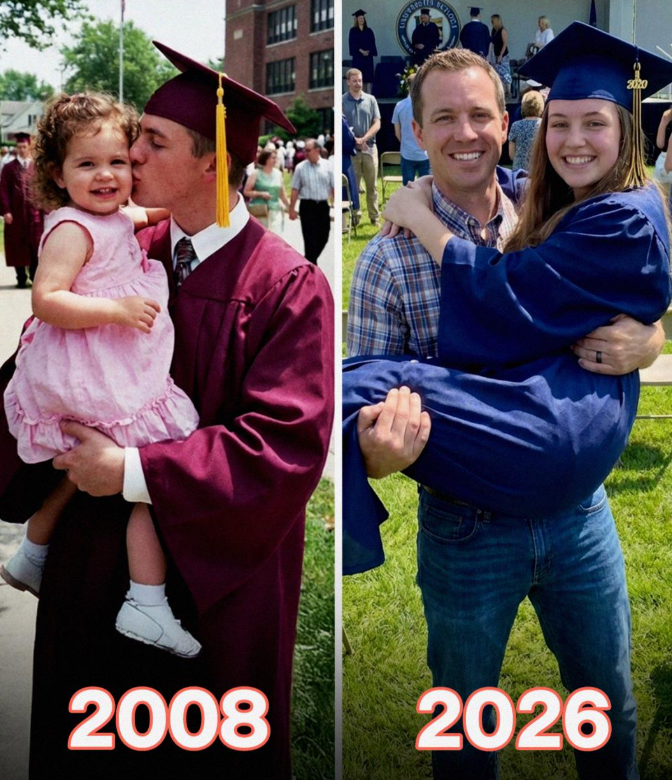
I clapped so loudly that the man next to me looked at me strangely.
I opened the front door and found two uniformed officers on my porch, under the yellow light. I felt an immediate, involuntary chill, like when you see a police officer at your door at 10 p.m.
The taller one spoke first. “Are you Brad? Ainsley’s father?”
“Yes, officer. What happened?”
They exchanged a glance. Then the officer said, “Sir, we’ve come to talk about your daughter. Do you have any idea what she’s done?”
“Are you Brad? Ainsley’s father?”
My heart was beating so hard against my ribs that I could feel it in my throat.
“My… my daughter? I… I don’t understand…”
“Sir, please relax,” the officer added, reading my expression, “she’s not in any trouble. I want to make that clear from the start. But we felt you needed to know something.”
But that didn’t calm my heart.
I let them in.
“But we felt you should know something.”
They explained it calmly and in order. For several months, Ainsley had been showing up at a construction site on the other side of town, a mixed-use development project with night shifts.
He wasn’t on the payroll. He had simply started showing up: sweeping, doing small tasks for the team, doing whatever needed doing, and staying out of it when it wasn’t necessary.
At first, the site supervisor turned a blind eye. Ainsley was quiet, responsible, and never caused any trouble. But when she started avoiding answering questions about paperwork and refusing to show her ID, the situation began to raise concerns.
She filed the complaint discreetly, just in case.
Ainsley had been showing up at a construction site on the other side of town.
“Protocol is protocol,” the officer said. “When we received the report, we investigated it. When we spoke with her daughter, she explained why she did it.”
I stared at him. “Why were you doing that, officer?”
She looked at me for a moment. “She told us everything. We just had to make sure everything was correct.”
Before I could answer, I heard footsteps on the stairs. Ainsley appeared in the hallway, still in her prom dress, and froze the instant she saw the officers.
“Why were you doing that, officer?”
“Hi, Dad,” she said quietly. “Anyway, I was going to tell you tonight.”
“Bubbles, what’s going on?”
Ainsley didn’t answer right away. Instead, she said, “Can I show you something first?” and disappeared upstairs before I could say a word.
She came downstairs carrying a shoebox. It was old, slightly dented at one corner. She placed it on the kitchen table in front of me as if it were something fragile.
I recognized it as soon as I saw the lettering on the side. Mine… from a long time ago.
He went back downstairs carrying a shoebox.
Inside were papers folded and unfolded until the creases smoothed out. An old notebook, its cover warped at one corner. And on top of it all, an envelope I hadn’t thought about in almost 18 years.
I picked it up slowly. I had opened it once, years ago, and then put it away as something I couldn’t allow myself to think about again.
It was an acceptance letter from one of the best engineering programs in the state. I was accepted at 17, the same spring Ainsley was born, and I put the letter on a shelf and never touched it again because I had more important things to figure out.
He didn’t even remember putting it in that box. And he certainly didn’t remember where the box had gone.
I opened it once, years ago.
“I shouldn’t have opened it… but I did,” Ainsley revealed. “I found it while looking for Halloween decorations in November. I wasn’t snooping. It was just there.”
“Did you read it?”
“I read everything in the box, Dad. The letter. The notebook. Everything.”